Unified search: a proposal
A proposal for delivering the unified search funded by CZI’s Essential Open Source Software program (EOSS cycle 6, Supporting and Sustaining Bioconductor Developers, funded in 2024). None of the search work in that grant has been built yet. This page proposes a rescope based on what exists now. Nothing here is decided. Counts are from 2026-10-02 unless another date is given.
Summary
The grant promised a unified search across bioconductor.org, the support site, code.bioconductor.org and the YouTube channel, built on a hosted search engine with a public API. Three of those four platforms have changed since it was written:
- The support site is being replaced by a new Discourse site.
- code.bioconductor.org is down: its certificate expired on 2026-08-30.
- bioconductor.org moved to a static build on Cloudflare in September 2026.
The original plan was mostly about collecting data: scrapers feeding one index. Most of that data now exists, or has an obvious home, in the modules built for the migration. What nobody has built is the hard part: retrieval quality and the experiences people actually use.
The proposal:
- Sustainability first. Anything that needs significant or costly infrastructure to run is out of scope (Figure 5).
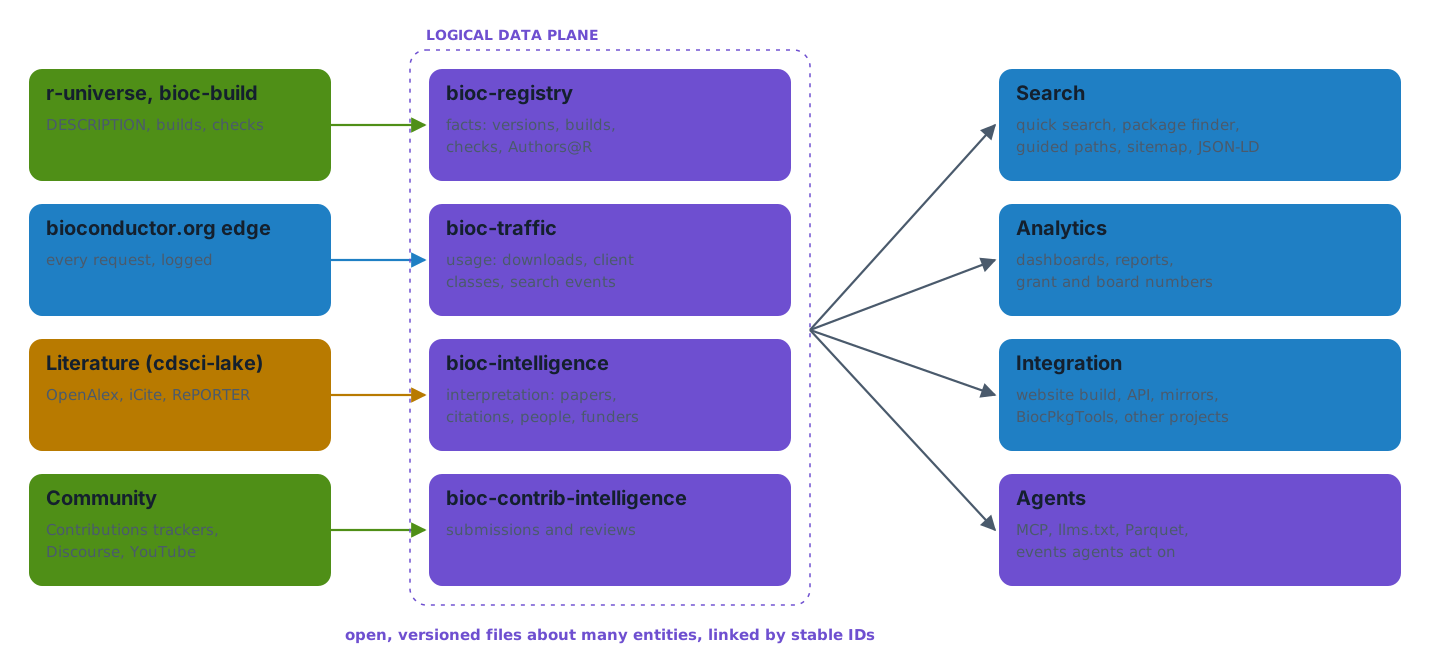
- The data plane is logical. It is a contract, not a machine: open, versioned files about many entities (packages, builds, people, publications, grants, requests, submissions), each published by the producer that owns it and linked by stable identifiers (Figure 2). It serves search, analytics, integration and agents equally. It isn’t a single server or search engine. Databases and search indexes can still be part of the infrastructure that produces it, or consumers that serve an application from it.
- Agents are first-class users, and with human review, contributors. Machines already make most requests to bioconductor.org (Figure 1).
- Search is several focused experiences, each matched to a persona (Table 6). General web search is left to Google, once the site stops blocking it.
- Retrieval quality is measured against a versioned test set before and after every ranking change.
- New sources and new functions plug in without changing what exists: a new producer publishes files under the same contract, and a new tool, skill or agent procedure reads them (Extending it).
- Decide with the data we already have. The request logs, the registry and bioc-intelligence already answer many design questions empirically. For example, a three-day look at the logs (Table 2) showed that Google sends about six times as many package-page visits as the header search box gets searches, and that most “searches” are Bingbot crawling result pages. Look before building, and measure after.
Guiding principles
Bioconductor’s infrastructure is run by a very small team on grant and volunteer time, and the project moved off its servers in 2026 precisely because they were costly to run and impossible for anyone else to take over. A search that needs its own servers would recreate that problem. So every component must:
- run from static files or pay-per-use serverless, with no standing bill and nothing to patch;
- be rebuildable from its sources by CI, so losing it costs a rebuild, not a recovery;
- be documented and tested where a newcomer, or an agent, can find it;
- justify itself against a measurement, not an expectation.
When in doubt, leave it out. A missing feature can be added later; a running service has to be paid for and operated indefinitely.
The data plane is logical. “Data plane” means the contract, not a system. Each producer publishes its slice as open, versioned files, and consumers link them through stable identifiers: package names, ORCIDs, DOIs, grant numbers, URLs (Table 4). bioc-registry owns facts with fixed definitions (versions, builds, checks, DESCRIPTION fields); bioc-intelligence owns interpretation (publications, citations, people, funders); bioc-traffic owns usage. Search is one consumer among several. The same files feed the website itself, dashboards, grant and board reports, mirrors, other projects, and agents. A producer can use a database or an index internally, and a consumer can load the files into a search engine to serve an application; neither becomes the data plane. Nothing in this proposal adds a central database.
Agents are first-class. People increasingly find and use software through AI assistants, and the project’s own maintenance increasingly runs through agents. Both need the same things search needs: stable URLs, pages that render without JavaScript, structured metadata, and bulk data with documented schemas. Designing for agents is designing for search. See Agents.
The new stack logs every request, the registry records every build and propagation, and bioc-intelligence links packages to the literature. That makes most questions about search, usage and impact answerable with a query instead of a guess, a survey or a vendor’s assumption. Table 2 took minutes to produce from the existing logs, and it changed priorities: crawlability before a better search box, and a robots.txt line before any new feature. Every proposal on this page should start the same way: what do the data say today? What measurement will show whether the change worked? Most of the possible measures need no new infrastructure.
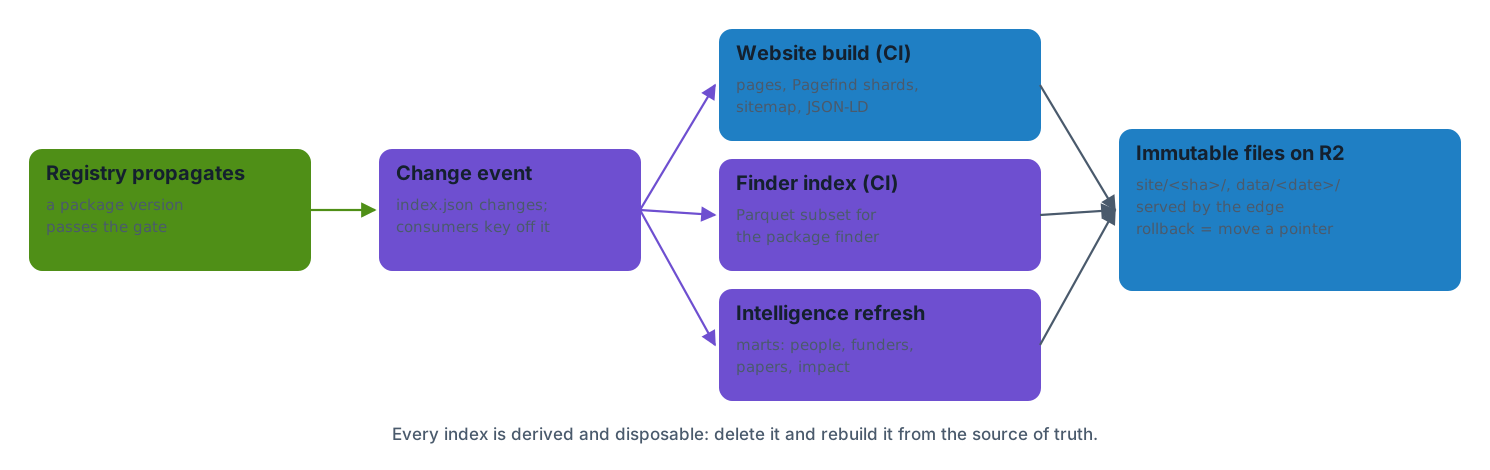
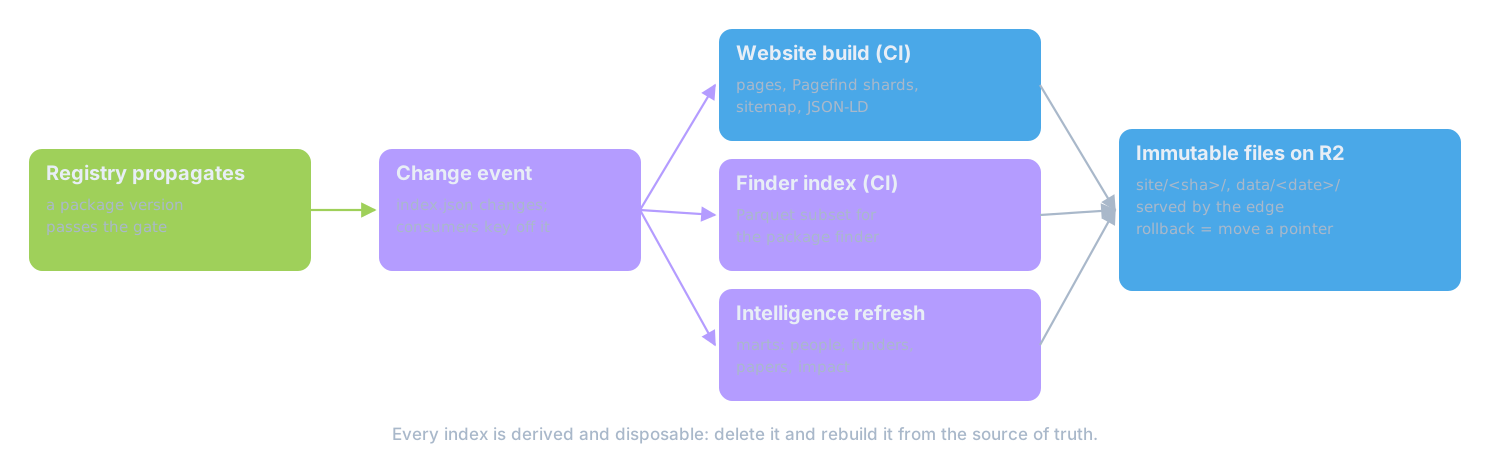
Indexes are derived. Every index, whether a Pagefind bundle, a Parquet extract, a sitemap or llms.txt, is rebuilt from the sources of truth and never edited by hand (Figure 3).
Open to extension. The contract is small enough that adding a data source or a capability means adding one producer or one consumer, not changing the others. See Extending it.
What changed since the grant was written
| When the grant was written (2023) | Now (2026-10) |
|---|---|
| Site search: legacy Solr. The grant’s own baseline: “edgeR” returned more than 7,500 results with no way to refine them | Solr retired (/solr returns 404). Pagefind runs in the browser over a static index built with the site. It covers release package names, titles and descriptions, and the prose pages |
| Site on AWS servers (master, staging) | Static Astro build in R2, served by a Cloudflare Worker since 2026-09-28 (how it works) |
| support.bioconductor.org (Biostar) | Being replaced by a new Discourse site, starting from scratch |
| code.bioconductor.org (code search, devel branch only) | Certificate expired 2026-08-30; not usable |
| Package metadata spread across the build system, VIEWS and BiocPkgTools | bioc-registry observes r-universe, gates propagation, and publishes an index plus Parquet |
Funding to come from the Authors@R fnd role |
Only 146 of 3,790 packages declare fnd. Publication-linked grants already cover more (below) |
| LLMs as an optional component | AI assistants and crawlers are regular clients of the site (Figure 1) |
| No search analytics | Every request is logged (ADR 0003). Queries typed into the Pagefind box are not |
Who uses the site
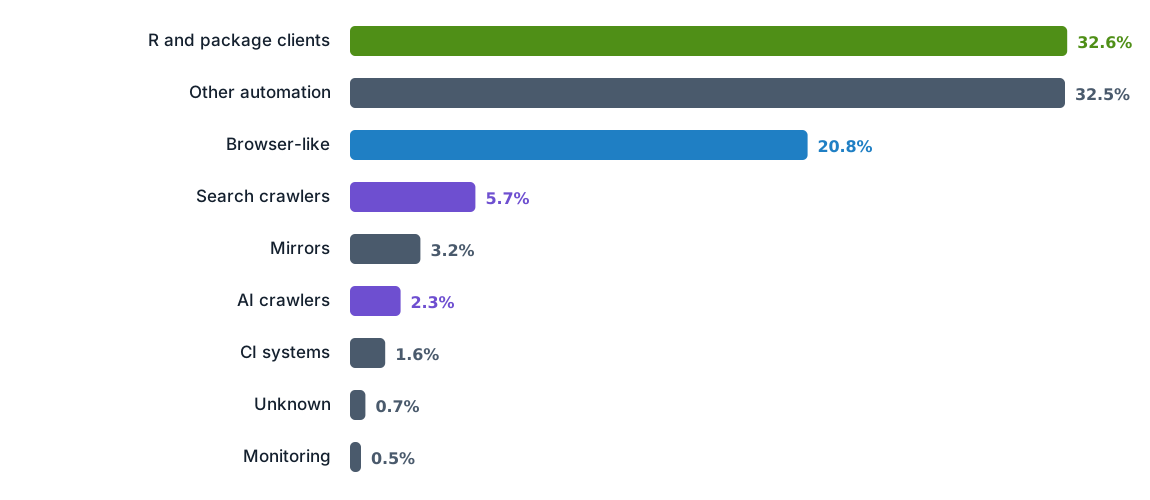
At most a fifth of requests even claim to come from a browser. Search crawlers and AI crawlers together make 8% of requests, and they are how most people will reach a package page. Whatever the project builds for search has to work for them first.
How search on the site is used today
bioconductor.org has no page analytics: the Astro build carries no analytics tag, and we found no Google Search Console or Bing Webmaster verification in the site’s pages or DNS. It may be verified some other way; we didn’t check further. The edge logs are the only record, and they see two kinds of search:
- The header search box submits to
/help/search/?search-bar=…, so the query is in the logged URL. - Pagefind’s own box runs in the browser. The logs show only the index files it fetches, not what was typed.
| Signal, 2026-09-28 20:09 to 2026-10-01 24:00 UTC (3.2 days) | Requests | Distinct clients |
|---|---|---|
| Header-form searches (query in the URL), all clients | 11,263 | 610 |
| … from declared crawlers | 9,968 | 172 |
| … of which Bingbot | 9,959 | 163 |
| … from browser user agents | 1,295 | 438 |
| … of which came from a bioconductor.org page | 1,239 | 412 |
| Pagefind index fetches (a query typed in the page), browser user agents | 718 | 418 |
| Header-form searches by browsers, per full day (09-29, 09-30, 10-01) | 446, 462, 347 | |
| Browser clients searching either way, per full day (09-29, 09-30, 10-01) | 167, 161, 128 | |
| Package landing-page views by browsers with a Google referrer | 8,657 | |
| … with an AI-assistant referrer (ChatGPT, Perplexity, Claude, Gemini, Copilot) | 74 |
What the logs already show:
- People do search the site: about 130–170 clients a day, and 350–460 header-form searches a day.
- Google matters more than the search box. It sent about 8,700 package-page visits in the same window, roughly six times the header-form searches. AI assistants sent 74, which is small but no longer zero.
- Most search requests come from Bingbot crawling search-result URLs: 9,580 distinct query strings in three days. Each is a unique URL with no unique content. robots.txt should disallow
/help/search/(added to bioc-website#33).
What nobody can see today: what people type into Pagefind, how many searches return nothing, which result they pick, and how bioconductor.org ranks in Google. Possible measures lists ways to see them.
What exists today
None of these modules was built under the grant. They are what a search effort would build on.
| Module | Holds or does | Runs on | Search-relevant role today | Gap for search |
|---|---|---|---|---|
| bioc-registry | Observes r-universe; the propagation gate; index.json with versions, DESCRIPTION fields, vignettes and commits; check history as Parquet; SQL in the browser |
Worker + R2 | Source of truth for package facts; the trigger for re-indexing | Software universes only; drops Authors@R (bioc-registry#63) |
| bioc-website | Renders package data and prose into static pages; builds the Pagefind index | GitHub Actions → R2 | Site search, package pages | No robots.txt, sitemap, canonical links or structured data of its own (#33–#36); vignette text not indexed |
| bioc-edge | The Worker serving bioconductor.org: routes, redirects, logging | Worker + R2 | Serves everything; can host small endpoints | Duplicate URLs, crawler headers (bioc-edge#55) |
| bioc-traffic | Request logs since 2020, client classes, download statistics | Batch job + private R2 | Popularity signals; header-form search queries are in the logs | No events from the Pagefind box; statistics not yet published |
| bioc-intelligence | 3,810 packages: biocViews, downloads, describing publications (961 packages), citations, NIH grants (613 grants, 265 packages) | Monthly batch job; static dashboard | Publications, impact and funding; dashboards | No people, ORCID or fnd (bioc-intelligence#23); NIH funders only |
| bioc-contrib-intelligence | Issues and timelines from the package-submission trackers | Batch job | Review history and precedent | Not package repositories |
| bioc-build, bioc-manifest | Builds the data and workflow packages r-universe can’t | GitHub Actions | Feeds the registry for non-software packages | Proof of concept |
| Discourse (new support site) | Questions and answers | Hosted, not by this project | Its own search, JSON API, crawlable | Whether the Biostar archive is imported is undecided |
The data plane
| Entity | Identifier | Source of truth | Produced by | Published as | Main consumers |
|---|---|---|---|---|---|
| Package (name, version, title, description, biocViews, dependencies) | Package name + version | DESCRIPTION via r-universe or bioc-build | bioc-registry | index.json, Parquet |
Website build, package finder, intelligence, agents |
| Build and check status | Package, version, platform, job | r-universe and bioc-build results | bioc-registry | Parquet, /next/ pages |
Package pages, maintainers, agents |
| Vignettes (list and titles) | Package + file name | r-universe metadata | bioc-registry → bioc-website | Page data | Site search, sitemap, guided paths |
| Vignette full text | URL | Built vignette HTML | New: indexed at site build | Pagefind bundle | Quick search, guided paths |
| People (authors, maintainers, roles) | ORCID, else a normalized name | Authors@R |
bioc-registry keeps it; bioc-intelligence parses it | Parquet | Package finder, profiles, dashboards, JSON-LD |
| Funders and grants | Funder name (normalized), grant number | fnd role; acknowledgements on linked publications |
bioc-intelligence | Parquet | Dashboards, package pages |
| Publications and citations | DOI, PMID | CITATION and DOI → OpenAlex, iCite | bioc-intelligence | Parquet | Package pages, researchers |
| Requests and usage | URL path, day, client class | Edge logs | bioc-traffic | Aggregated Parquet, no client addresses | Ranking tiebreaks, dashboards, download statistics |
| Submissions and reviews | Tracker issue number | Contributions trackers | bioc-contrib-intelligence | JSONL, Parquet | Review precedent, agents |
| Support questions and answers | Topic ID, tags | Discourse | Discourse | Its own search and API | Linked from site search and package pages |
| Videos | YouTube video ID | YouTube channel | New, small: a curated index | Static JSON | Guided paths, package pages |
| Code search | none | Out of scope until code.bioconductor.org has an owner |
How indexes stay current
Personas
The requirements draft listed 31 user stories, nearly all built around one package (DESeq2) and one maintainer. Most of them are lookups and reports, like “show the download statistics for DESeq2” or “list developers with more than five packages”. They don’t say what people are trying to do, or where they start. Table 5 replaces them with personas. The next step is to write two or three concrete tasks per persona, each a starting query plus the answer an expert would accept. Those tasks become the retrieval test set (I1). The personas written for the agent harnesses in bioc-harnesses (maintainers, analysts, core team) are a starting point for the developer and analyst rows.
| Persona | Trying to | Example needs | Best surface | Data exists? |
|---|---|---|---|---|
| New user (biologist or analyst) | Get from a data type to a working analysis | “I have bulk RNA-seq counts, what do I use?”; “how do I install?”; “convert gene symbols to Entrez IDs” | Google, then guided paths and vignettes | Packages and vignettes yes; curated paths no |
| Single-cell user | Assemble a workflow across many packages | “Which packages do QC, normalization and clustering for scRNA-seq?” | Guided path built on OSCA and biocViews; package finder | Yes; path curation no |
| Package user with a problem | Fix an error, understand a method | “DESeq2: every gene contains at least one zero”; “how does limma handle batch effects?” | Google, Discourse, vignette full text | Discourse yes; vignette text not indexed |
| Developer or maintainer | Build and maintain packages | “Who else implements X?”; “what depends on my package?”; “why is my build red?” | Package finder (reverse dependencies, biocViews); build pages; contributions guide | Yes (registry) |
| Prospective contributor (from Python, tidyverse) | Find where they fit | “Which packages work with AnnData and scverse?”; “who maintains this ecosystem?” | Package finder and people profiles | Packages yes; people pending |
| Open-source software researcher | Study the ecosystem | Dependency networks, maintainer load, citation and funding patterns, growth | Documented Parquet; SQL in the browser | Mostly yes |
| Bioconductor leader (core team, boards) | Steward the project | “Which funders support our packages?”; “which high-impact packages have one maintainer?” | Dashboards | Publications and NIH yes; people and other funders pending |
| Educator | Find teaching material | Videos, workshops and books on a topic | Guided paths; video index | Books yes; videos not indexed |
| AI agent, for any of the above | Answer accurately, act on events | Current APIs, which package to use, why a build failed, how a submission compares | Crawlable pages, JSON-LD, llms.txt, Parquet, MCP |
Partly; structured data pending |
Search experiences
| Experience | Serves | How | Cost model |
|---|---|---|---|
| Google and other engines | Everyone, long-tail questions | Unblock crawling, a real sitemap, canonical links, structured data (bioc-website#33–36, bioc-edge#55) | None |
| Quick site search | People who start on bioconductor.org | Pagefind, adding vignette full text, type badges, separate bundles per surface merged in the browser, and a feedback button on results (“found it” / “didn’t find it”, plus an optional “report a missing result” link into the existing issue forms) | Static + a tiny Worker endpoint |
| Package finder | Developers, single-cell users, contributors | Facets (biocViews, repository, maintainer, ORCID, build status, reverse dependencies) over registry and intelligence Parquet, queried in the browser | Static + browser |
| Guided paths | New and domain users, educators | Curated pages per data type or task, kept as versioned files with named maintainers and CI checks against the registry | Static |
| Support | People with a problem | Discourse’s own search; site search links out with the query filled in; package pages show recent topics | Discourse’s |
| Data and agent access | Researchers, tool builders, agents | Documented Parquet, llms.txt, JSON-LD, and an MCP server over the same files if demand appears |
Static + Worker |
| Dashboards | Leaders, researchers | The bioc-intelligence dashboard, extended with people and funders | Static + browser |
Agents
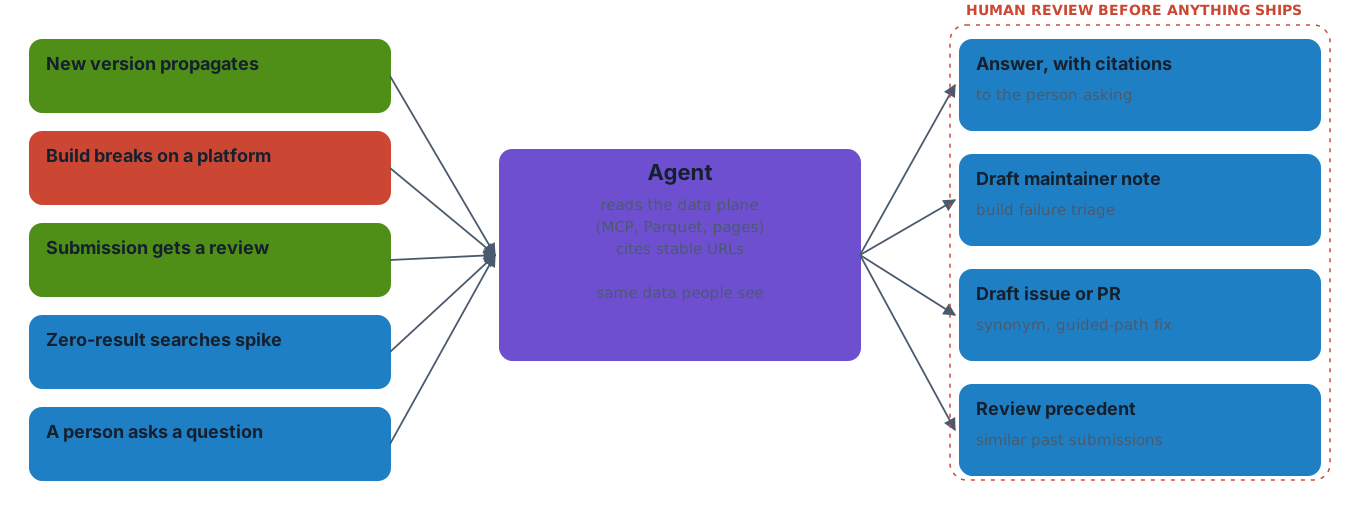
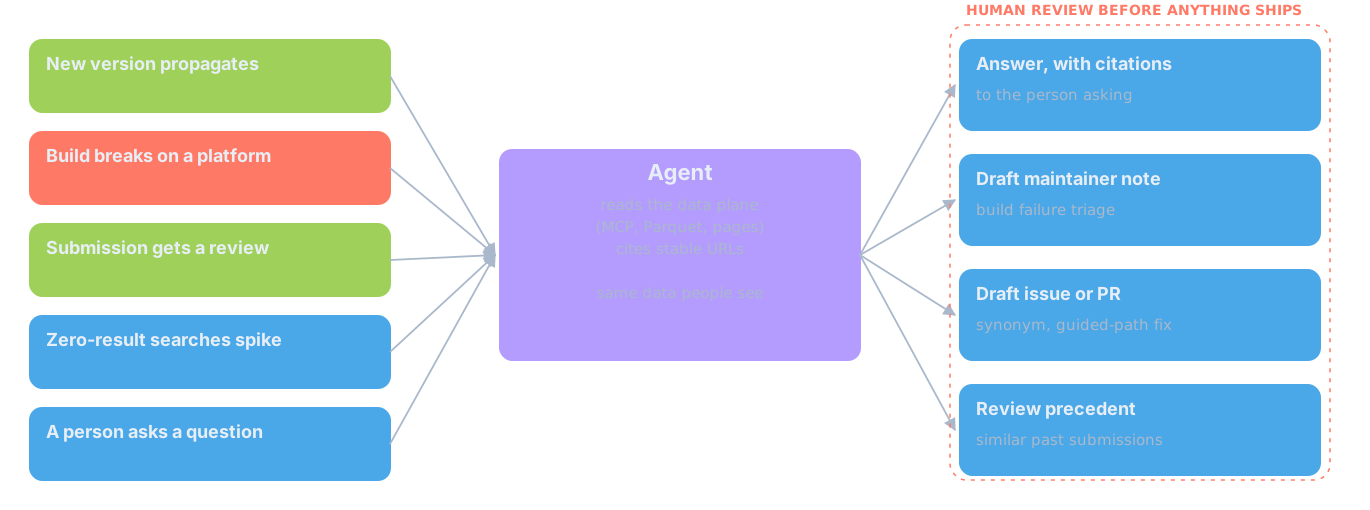
Agents matter to this proposal in three ways.
- As readers. Assistants answer questions about Bioconductor every day, from whatever they can crawl. Crawlable pages, JSON-LD,
llms.txtand Markdown twins of pages (this site already publishesllms.txtthat way) decide whether those answers are current and correct. This is the cheapest search investment with the widest reach. - As actors. The data plane emits events: a version propagates, a build breaks on one platform, a submission gets a review, zero-result searches spike. An agent subscribed to them can draft a note to a maintainer, triage a failure, suggest a synonym or a fix to a guided path, or find precedent for a submission. Answers must cite their sources (I12), and anything that changes the project goes through human review.
- As maintainers. The modules in Table 3 were built and are maintained with agents. That only works because each one is small, documented, tested and rebuildable. The sustainability rules above are also what makes agent maintenance safe. A hosted search cluster is exactly the kind of system an agent can’t safely operate.
Extending it
Search is one consumer of the data plane among several. The website itself, the /next/ package pages, the bioc-intelligence dashboard, mirrors and BiocManager already read parts of it today. The design has to make it cheap to add both new data and new capabilities.
A new data source (the Discourse site, workshop materials, Hub resources, conference talks) joins by publishing files under the same contract as the existing producers. It needs:
- an owner, meaning one repo and one maintainer;
- stable identifiers for its own records, and links to existing entities through theirs (package name, ORCID, DOI, grant number);
- a documented schema with dated snapshots and a
latestalias; - a rebuild from its own source of truth, run by CI or a scheduled serverless job;
- no private data in the published files.
Nothing downstream has to change for the source to exist. Each consumer opts in when it’s useful.
A new capability is a new consumer of those files. Besides interfaces for people, the capabilities with the most leverage are for agents:
- Bioconductor’s AI agent skills teach coding agents the project’s conventions and workflows.
- Agentic standard operating procedures (SOPs) behind those skills turn recurring work into written, reviewable steps. Examples: triaging a build failure, pre-reviewing a submission, refreshing a guided path when a package is deprecated, answering a support question with citations.
- Harnesses like bioc-harnesses package the skills and procedures for maintainers, analysts and the core team.
All of these read the data plane through the same files, pages and (if built) MCP server. They are triggered by the same events (Figure 4), and their output goes through the same human review.
That gives the data plane a single, stable job: be the dependable, documented ground truth that people, tools, skills and agents all build on. A skill or SOP needs current package facts, build state, usage and literature. With the data plane in place, it can get them by reading files instead of scraping websites.
Sustainability and cost
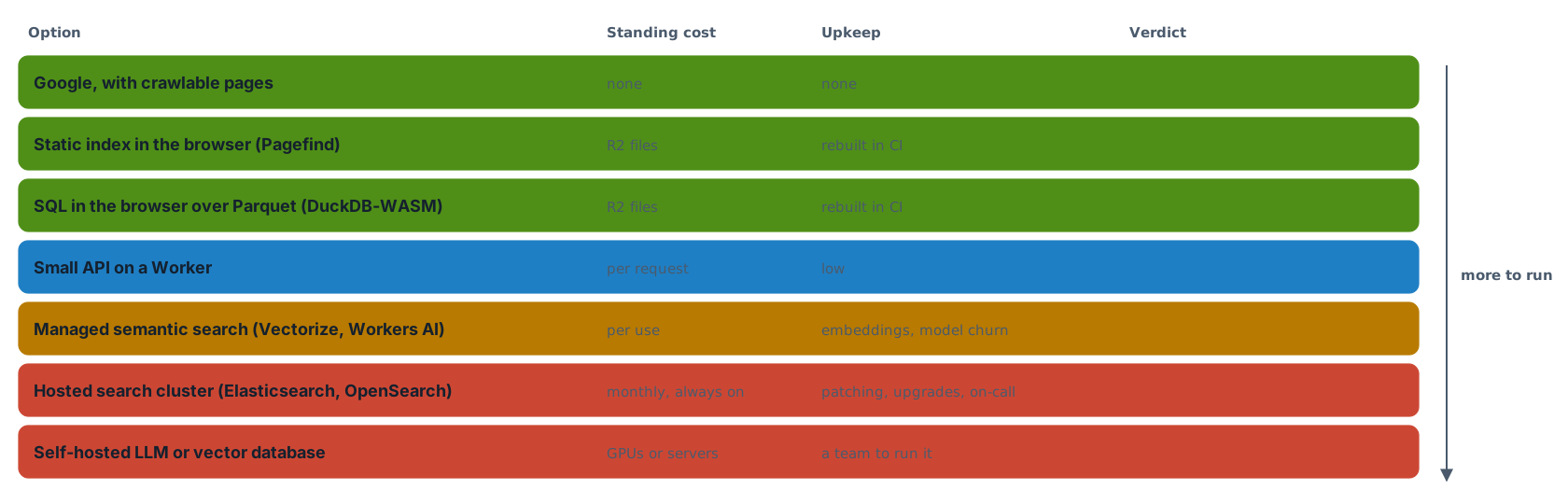
The new stack serves bioconductor.org for roughly $240–500 a month, against about $5,000 for the AWS estate it replaces (costs). A managed search cluster would add a standing monthly bill of its own, plus patching, upgrades and someone on call. It would do that for a site whose search traffic Pagefind already handles from static files (Table 2). That is why running one is out of scope for this effort. It isn’t ruled out by the design: a search engine fed from the data plane’s files is a legitimate consumer, if someone has a need for it and the means to run it. The original plan’s hosted engine and public API are the main things this proposal drops.
Two operational risks are known for the static approach:
- DuckDB-WASM range reads. Newer versions of DuckDB-WASM have been reported to download whole remote Parquet files instead of byte ranges (duckdb-wasm discussion #2247). Pin the version, and add a CI check on bytes transferred.
- Pagefind size. Pagefind loads only the index chunks a query needs. Its documentation cites about 300 kB of payload for a 10,000-page site (pagefind.app). Adding vignette full text will grow the index, so measure that before and after.
Possible measures
Ways to tell whether search, and the site’s findability in general, are working. These are possibilities, not commitments. Most use data already collected; the rest are cheap to add.
| Area | Measure | What it tells us | Source | Available today? |
|---|---|---|---|---|
| Site search use | Searches per day by people vs crawlers; clients searching | Whether the search box matters, and to whom | Edge logs (header form) | Yes (Table 2) |
| Site search quality | Queries typed, zero-result rate, result clicked and its rank, reformulations | Where search fails people | Pagefind events, sent to a Worker and Analytics Engine (I15 privacy rules) | No; a small addition |
| Explicit feedback | “Found it” / “didn’t find it” on a results page, with the query and the rank of any clicked result; free-text reports of a missing result | Which queries fail, in people’s own judgement; new cases for the test set (I1) | A feedback button posting to a Worker and Analytics Engine; reports through the existing issue forms | No; a small addition |
| Retrieval quality | NDCG@10 and recall@10 on the persona test set; exact package name ranked first | Whether a ranking change helped, before it ships | CI over a versioned test set (I1) | No |
| Impressions, clicks, click-through and average position per page and query, over time | How people find packages and vignettes from the web | Google Search Console (free, with an API) | Not set up, as far as we found | |
| Other engines | The same for Bing | A second view of web findability | Bing Webmaster Tools | Not set up, as far as we found |
| Index coverage | Pages in the sitemap vs pages indexed; crawl errors | Whether the crawlability fixes worked | Search Console, sitemap | No (no sitemap yet) |
| Crawler activity | Requests by search and AI crawler, by path class, over time | What crawlers read, and what they waste | Edge logs, bioc-traffic client classes | Yes |
| Referrals | Landings by referrer: Google, other engines, AI assistants, other sites | Which doors people come in through, and how that shifts | Edge logs (Referer) |
Raw data yes; no report |
| Agent consumption | Fetches of llms.txt, .md pages, Parquet files; MCP calls |
Whether agents use what is built for them | Edge logs, Worker | Partly |
| Package reach | Landing-page and vignette views by people, per package, over time | Which packages and documents people actually read | Edge logs + client classes | Partly (v0 classes) |
| Support | Searches and no-result searches on Discourse | Gaps in answers and documentation | Discourse admin reports | When the new site launches |
| Freshness | Time from a propagation to the updated page, index and Parquet | Whether “current” is true | Registry ledger, build timestamps | No; derivable |
| Cost | Monthly cost of each search surface; bytes per search | Whether sustainability holds as usage grows (I14) | Cloudflare analytics, Pagefind payloads | Partly (estimates) |
| Agent outcomes | Agent drafts merged, edited or rejected | Whether agent work saves time | GitHub | No; derivable |
Invariants
Rules that should hold whichever engine or interface is chosen. Each one comes from a source we read on 2026-10-02.
| # | Invariant | Why | Source |
|---|---|---|---|
| I1 | Judge search against written-down information needs in a fixed, versioned test set; tune on a separate set | Relevance is judged against the need, not the query; tuning on the reported set overstates quality | IIR ch. 8 |
| I2 | Query logs are an evaluation input: track zero-result queries and reformulations | The most overlooked source of search problems; fixes are synonyms and “best bets” | NN/g |
| I3 | An index is derived: rebuilt from the sources of truth, never edited, stamped with its inputs | Fixes belong upstream; a lost index costs a rebuild | Pagefind, crates.io policy |
| I4 | Publish bulk, static, versioned files first; every interface is a consumer of them | crates.io points heavy users at a daily dump and rate-limits its API; R2 egress is free | crates.io policy, R2 pricing |
| I5 | Facets need controlled, consistently assigned metadata, generated from the data, not hand-tagged | Faceted navigation fails when labels are inconsistent or don’t match how people think | Hearst, Search User Interfaces ch. 8 |
| I6 | Start with a lexical (BM25-class) baseline; add semantic or hybrid retrieval only for a measured gain | Across 18 datasets, BM25 is a robust baseline; better re-rankers cost much more | BEIR |
| I7 | Rank an exact name match first, then text relevance, then popularity as a tiebreaker; publish the signals | How crates.io, npm and r-universe rank packages | crates.io search, r-universe |
| I8 | Curated guides are data with an owner, a date and automated checks | CRAN Task Views: named maintainers, versioned, CI-checked against CRAN | CRAN Task Views |
| I9 | Every result shows why it matched: title, a snippet around the matched terms, its type | Query-biased snippets beat lead sentences; people choose results by their “scent” | Hearst ch. 5, NN/g |
| I10 | Search never dead-ends: zero results say so and offer next steps; facets never lead to empty sets | No-results pages drive abandonment | NN/g |
| I11 | One stable, canonical, pre-rendered URL per entity, linked with plain <a href> |
Crawlers can’t follow fragment URLs; canonical links consolidate duplicates | Google: canonicals, Cool URIs |
| I12 | Generated answers cite retrievable sources; source text stays the primary artifact | The best models lacked full citation support about half the time | ALCE |
| I13 | Machine-readable metadata (JSON-LD, sitemap, llms.txt) is generated from the same records as the visible page |
Google ignores markup for content that isn’t on the page, and lastmod that isn’t accurate |
Google: structured data, llms.txt |
| I14 | Running cost scales with content, not with traffic | Static indexes and free egress make a traffic spike cost nothing extra | Pagefind, R2 pricing |
| I15 | Log queries for aggregate analysis only: no addresses or user IDs, short retention, never publish raw logs | Numbering users did not keep the 2006 AOL search logs anonymous | NYT |
Practices to avoid, from the same sources:
- A hosted search cluster for a low-traffic site. Even crates.io, which runs server-side search, only ranks the top 1,000 candidates, because ranking every match is “prohibitively expensive”.
- LLM summaries in place of source text, or answers without citations.
- No test set, or tuning on the set you report.
- Content that only appears after JavaScript runs, or deduplicating pages with robots.txt instead of canonical links.
- Keeping raw addresses or user IDs in query logs.
Funding data
The grant planned to find funders through the Authors@R fnd role. That is the weakest route:
fnddeclarations: 146 of 3,790 packages (3.9%) in Bioconductor 3.24. Many name a PI rather than an agency, and CZI alone appears under at least five spellings.- Publications: bioc-intelligence links 961 packages to a describing publication. Through NIH RePORTER alone, 613 NIH grants already attach to 265 packages. Most of those papers acknowledge grants, but only NIH links are captured so far. Adding other funders from publication metadata (for example OpenAlex funder records) is the larger gain.
- What
fndadds: funders a package declares but its paper doesn’t acknowledge. It reaches bioc-intelligence throughAuthors@R(bioc-registry#63, bioc-intelligence#23).
“Which packages did CZI fund?” belongs on a dashboard backed by publication funding plus fnd. It isn’t a search query.
The original plan
The 2023 application and a 2024 requirements draft describe one search index fed by four scrapers (packages, YouTube, the support site, package code), a Python API over it, an optional external LLM, and a public API so that R users could query the index directly. Compared with today:
- The index and API were the plan’s centre. This proposal keeps the intent: developers can analyse Bioconductor data, and the website gets one search entry point. It moves that intent onto files and browser-side search (I4, I14).
- Two of the four sources have moved. The support site is moving to Discourse, and code.bioconductor.org has no owner. The packages source is now the registry.
- The user stories were reports, not searches. They are replaced by personas (Table 5).
- Video summaries were to be LLM-generated. An index needs titles, descriptions and transcripts, not summaries (I12). Linking videos to packages by name is unreliable for packages named with ordinary words, so a small curated index is cheaper and more accurate.
- No success metric or analytics were planned. The grant’s own baseline (7,500 results for “edgeR”) becomes test case zero (I1, I2).
Proposed sequence
- Crawlability: robots.txt, sitemap, canonical links, URL normalization, structured data (bioc-website#33–36, bioc-edge#55). Small changes with the largest immediate effect, for people and agents alike.
- Data plane gaps:
Authors@Rinto the registry; people, ORCID and funders in bioc-intelligence; non-NIH funders from publications; registry coverage of data and workflow packages through bioc-build. - Measure: a standing report from the logs we already have (Table 2); Google Search Console and Bing Webmaster Tools for bioconductor.org; the persona test set; anonymous query and zero-result events from Pagefind (Table 7).
- Quick search and package finder: vignette full text in Pagefind; a feedback button on results; facets over Parquet in the browser.
- Guided paths: start with RNA-seq and single-cell; link Discourse tags and a curated video index.
- Data and agent access: documented Parquet,
llms.txtfor package and vignette pages, events, and an MCP server once the persona work shows demand.
The search design ADR on the roadmap (M3) should record the decisions taken here.
Open questions
- The award’s end date, any extension, and the budget left for search.
- Will the Biostar archive be imported into Discourse? If not, years of answers drop out of Google and out of reach of agents.
- Does anyone own code.bioconductor.org? If not, it leaves the scope.
- Who does the interface design: grant-funded staff, a contractor, or the champions program the same grant funds?